Friday, April 20, 2012

Jaworska"s loom has a new home


A couple of Months a go I came across an add referring to a loom for sale. After inquiring a little bit more, I found out that it was not just A loom. It was the wonderful historical artifact in which Tamara Jaworska had made most of her wonderful tapestry production. As you all know,
Tamara Jaworska is the most renowned Canadian fiber artist and weaver in the discipline of tapestry/gobelin, Her amazing tapestries have won her national and international recognition.

Her skill as an artist-weaver belongs to the disciplines that were born more than five hundred years ago, while the pictorial essence of her tapestries is pure twentieth-century: dynamic and original in design, splendid in colours and filled with new and surprising forms. "Tamara Jaworska is an artist whose gobelin-tapestries reflect the sensibility, intelligence and vigor of a dynamic personality" wrote Glen E. Cumming.


Being a weaver for such a long time you learn that tapestry is a slow, meditative art expression. It relates to get closer to your loom. Being immersed into your work for months and months, this artifact becomes part of you. It is precisely when I realized that this loom has an essence of its own. Tamara had woven more than 100 tapestries in this precise instrument.
First I received a note from a friend of mine and wonderful weaver, Kate Kitchen. She sent me all the information and encouraged me to think about it. She knew about my interest in teaching and in sharing the experience of weaving with peers, colleagues and friends.
Honestly, as much as I wanted, it was just a matter of wanting. For several reasons I though twice. First of all, the economical factor was one of the most important issues. Not that this loom was worth each cent of it, it is the fact that I am starting my own Art school and it required quite an investment for me already.


Secondly, the space factor: back in my Country, Mexico, I owned a private textile school where I offered all different kinds of textile approaches. I knew the space required for these types of looms, for I had 7 of these, and living in different parts it is not easy to allocate them, sell them, or even give them away for free. They can use almost one full room, which with my art school I am already committed to restrict the space available.


Thirdly, relating to health, I have been struggling with a tendinitis on my right elbow that needs to be addressed sometime soon....
So as you see, the decision was not easy. As much as I wanted to revive the energy and try to get as much as I could from Tamara's good and wonderful vibes, my decision to pass on this opportunity was just fast to say.
However, weeks passed and I was just not comfortable on this decision. In my studio, the oakville Tapestry Studio, all the members where as excited as I was still just by the thought of being close to this loom. I has nightmares, dreams, thoughts....all came to me all at the same time.
I was thinking: well, the money I don't have, but what if I do an effort. This would be really worth the time and thought put into this. I am a person who loves to teach, and it was precisely one of the conditions that Monica Schut, great artist and the previous soul keeper of this wonderful piece and friend of Tamara's, who had in her possession the loom for over 15 years made as a request.
She mentioned to me at the first interview with her, that what Tamara wanted was to make this loom a significant tool for new generations to learn from.
This is not only one single loom. It was manufactured and custom made for Tamara from one of the most important builders from Poland. It was made of a special Polish hard wood tree and brought by boat over 40 years ago. Tamara had made all the specifications to have it made exactly as she required to weave large scale tapestries.
Weeks again passed by and I had no other than to think of this wonderful loom, and just the thought that it might be going to to another studio, it just made me so sad.
That week, the odds where on my side. I managed to sell 2 tapestries and that was the signal! This loom had to be for our Studio. Where other people would take advantage of the use and just to see it operating it again was a wonderful idea. But where? Space was another important issue. There came Stella. One wonderful member of our Studio who immediately jumped into the emergency:She said: " I have room, I have my basement where I have all my art studio "...I have to say that Stella not only is a wonderful weaver, jewelery designer, but a quilter, painter, bead work and needle weaving...among many other crafts, she is a truly giving person.
 I could not believe this! Everything just had such an energy to have this loom brought into our lives. Into life again!
I have loved large scale for a long time. Our Studio is now in the beginning of exploring the large format, and what better that by using this magnificent loom.


Here I am with Monica, who showed us all of Tamara s works, awards, posters and images that came together with the loom.
 Below is one of Tamara's Quartet Series. Magnificent in image and stunning to see them live at the First Canadian Bank.


More images still to come, but for now let me share these ones. Here in the picture is Yamile, Stella, Petar, Myriam and Mari Carmen. All together we brought piece by piece the loom into the basement. it creates a warm atmosphere already.
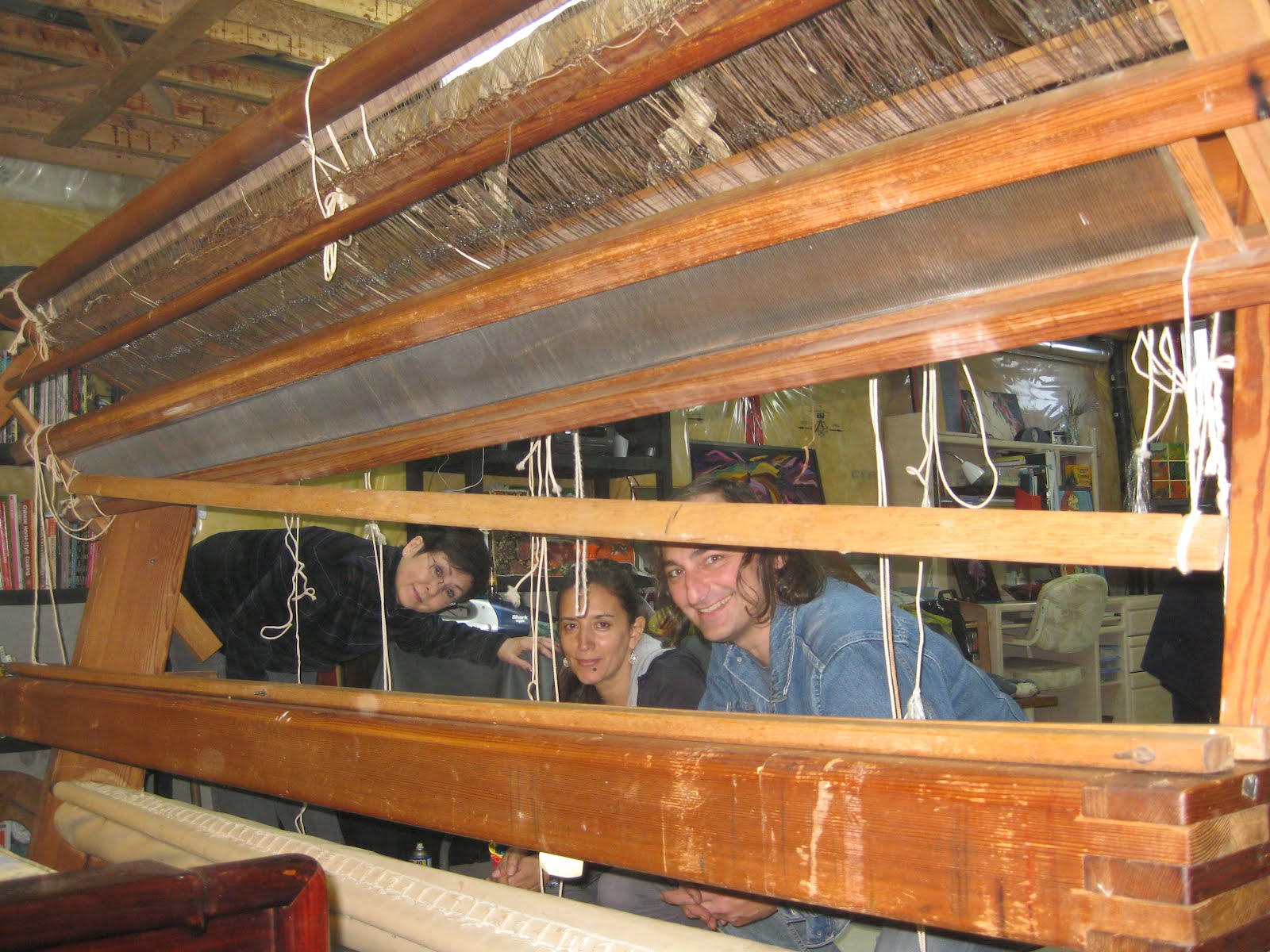

Thank you guys for making this dream come true.


Friday, January 27, 2012

Exhibit at the Mississippi Valley Textile Museum


Polish pride weaves its tapestry spell in Almonte - Entertainment - By Desmond Devoy Almonte/Carleton Place Entertainment Arts


I would like to take this space to thank Krystyna sadej for inviting me and all the participant artists: Thoma Ewen. Thomas Chronenberg, Monique Lehman, Ewa Mazusz-Bartosz.
All together we presented a very eclectic yet interesting view of contemporary tapestries in Almonte, Ontario, at the Mississippi Valley textile Museum.


I appreciate the press review presented by Desmond Devoy. It is always important to show Public in general the presence of the fibre arts, especially tapestry. It is such a delicate, time-consuming technique that the awareness of such manufactures by the community is essential.

Monday, December 26, 2011

Ontario Arts Council Big Thanks


A year has passed and it is time to reflect upon all the wonderful projects accomplished. This year i had the opportunity to receive the Visual Arts Grant from the Ontario Arts Council as I have mentioned before in several occasions. I have to thank this organism that enables us, artists, to keep up our art by supporting economically.


The Mayor Rob Burton honoured us to do the cutting of the large tapestry woven at Joshua Creek Heritage Art Centre who opened its wing in the attic for us to weave. We thank Sybil Rampen for her initiative to host the loom on her facility.


Thanks to the Grant I was able to produce different and new ideas in the fibre field such as these trees. Since it was destined the 2011 as the UN International Year for Trees and Forests, I created this installations with the assistance of Sophie Kudukis.


Textures from the Air, an interesting Installation woven in tapestry technique was selected to be displayed at the Museum Diego Rivera in Mexico City during the VI International Biennial of Contemporary Textiles May 2011

Scars From Nature was one of the 3 tapestries woven during this GRANT Year.

It is not only the money received. it is the possibility to destine time and all your effort into a creative passion. The art field is difficult if you intend to live on it. I teach painting and for other things in order to sustain my art. Weaving is not a very well know technique and it is very time consuming. The production of one sole tapestry woven by one person can take from 2 to8 months, depending on the size, the separation of the warp, the materials, or the design. Thanks to the support of the Ontario Arts Council I was able to:


- produce more artwork and leaving my painting classes a bit behind,
- buy new and interesting specialty yarns,
- create more installations different to what I was doing,
- explore new mediums (Multi and integrated media)
- Participate in more international forums,
- spend more time writing on tapestry and fibre art publications...

For this and more...thanks to:

I would like to encourage artists and all creators who depend on their art to approach these wonderful institutions for support. They are there for us!

Wednesday, December 7, 2011

Scars from Nature


Amazing camping . Scars from Nature


My Latest tapestry


Last fall, after participating in the 13 Moons International Exhibit in Gatineau, we had the opportunity to spend some family time together with my kids and my husband camping in a wonderful site . There, not only the wilderness of the place was fascinating due to the exuberant deep thick forest, but also for the many different creatures and living species growing around.


It was in one of those hikes that my daughter Sofia decided to make a stop and take a picture. She was amazed about these yellow fungus growing here and there

.


She called to show us the picture she took. The hike kept on going with random pictures from here and there.

On our return, I was really happy to see that she not only has a view for choosing interesting views and different things through the lens, but also to notice she has such an artistic sense of composition.


The image of the fungus was really interesting. The intricate interior of a burned tree created some scars that only time and weather are able to create.

Thanks to the support of the Ontario Arts Council I was able to have assistance in the weaving of this tapestry. Here is Yamile Roa, member of the Canadian Tapestry Network, the Tapestry Studio, the HGA of America and the Oakville Handweavers and Spinners Guild.

Thank you for your help, especially now that I have been under cortisone in my right elbow due to tendinitis.

This tapestry was interesting to weave especially for the different materials used. Specialty yarns where carefully selected and the colours we obtained were so interesting.

Friday, November 25, 2011

creating music inspired in textures


How can fibres inspire a wonderful creation?


Today I would like to share this space to talk about Music, inspirations and proposals...
An inside view of a wonderful friend of mine: Victor Del Corral.

We met in 1976 in Mexico City while in Elementary School. We spent most of our elementary studies together. Not only he was a very intelligent fellow, he could play tennis and guitar in such a way everyone admired him since then.

Our paths took us else were in our lives. He lives in USA, I live in Canada, and for a long time we knew nothing about us.
For some reason, our paths had to cross again, and this time in such a fabulous way that we are now collaborating together into textile-multi-media projects.

Find below a bit of his work and share the spirit of a great musician and artist!


How did you start in music?

I started studying guitar when I was 7 years old, and continued taking classical guitar lessons when I was 11 years old. After a few years of learning classical guitar I started composing my first own songs
and I enjoyed very much the fact that I could create something new. By that time I also started playing
electric guitar and formed a hard rock band. That was the perfect outlet for me to continue writing songs
and creating new music. A few years later, I started experimenting with synthesizers and got immersed in
electronic music. The possibilities you have composing electronic music are almost endless, and that is
what I have been focusing on during the past years.


What is your favourite style or period in Music?

My favorite music style is 20th century classical music; I always wondered who the new Mozarts and
Beethovens were and got pleasantly surprised when I started digging into contemporary classical music,
finding composers such as Edgar Varese, Luciano Berio, Gyorgi Ligeti, Giacinto Scelsi and Morton
Feldman. Their music goes beyond traditional boundaries and fearlessly explores new sonic territories. I
also listen a lot to electronic ambient and minimalist composers, such as Brian Eno, Taylor Dupree and
Richard Chartier.

Who could you say is your inspiration?

I admire Brian Eno very much, and he is a big influence in my composing style. He is one of the most
creative musicians I know, and his work encompasses music, video production, photography and light
installations.


How do you start your music creations?Where do you get inspiration from?

My main source of inspiration to create music is through paintings. I am a very visual / sensorial
person and I enjoy very much looking at abstract paintings; colors and textures on paintings transmit
me different feelings and emotions, and I try to represent those with music. I often “draw” my pieces
first, as a raw score to be used as the foundation of the composing process. The basic structure of a
piece is represented there and I make notes about the quality and texture of sounds to be used. I love
sound as such, and can play with a sound for hours until I get it right. I think of sounds in terms of color,
temperature and texture, for example, I may want to use an “orange” bass line, a warm yellow string pad,
that can also be round, edged, smooth, rugged, etc.


What do you think about all the technology being incorporated in musical production versus acoustic instruments?

Using technology to compose music is a great advantage in my opinion. In the past, you could only
compose music for one instrument, and in current times, you are able to compose a full score including
many different instruments, and that allows you to be more creative. I have often heard people saying that
with current technology anyone can compose music, but I have a different opinion. Technology expedites
the process and increases the possibilities but it doesn’t make you a better composer. You still have to
have a clear idea of what you want and how you want it to sound to create something beautiful.
I use analog synthesizers to compose, with no predetermined sounds on them and similar in a way to old
manual cameras; you first “sculpt” a sound, choosing a wave types and applying filters to get the sound
you are looking for. Once you have those sounds available, then you start composing using them. It is a
very “hands on” approach although you are using advanced technology in the process.

What type of fusion is most appealing to you?


I love blending electronic and acoustic instruments, having the precision that computers give you

interweaving with the raw feeling and intensity you get playing acoustic instruments. Recording with
acoustic instruments is very interesting and challenging, as you have only one chance to get the piece
right while recording. The subtle imperfections and flaws of the acoustic elements, contrasting with the
structured and very precise electronic elements is what makes the fusion so incredible.

Could you tell us something about your Maquinaria and Prana Music?

I have two very different styles and compositions approaches I use to produce music, thus, the two artistic
names I use.

Maquinaria music can be classified as Ambient Techno. That music is very dynamic and always has a
beat; I use lots of electronic equipment and sound processing to create it, and it conveys ideas about
things that I enjoy in life, like feeling grateful, contrasting simple things vs complex things, feeling upbeat
and radiating, the beauty of created systems, etc. I normally play live instruments, such as guitar of
keyboards on those compositions, and I can think about that music as very colorful. I also experiment a
lot using “new” unusual / experimental sounds that I create for those pieces.

Prana pieces are the other side of the coin, very long pieces that subtly evolve and morph in time, having
no rhythm and no identifiable melodies. Those pieces are created with the purpose of “being” with you
while working on a task or activity on which you want to focus on, but demanding no attention from you
while playing it. I often refer to Prana music as putting a color or a mood into the room you are in. The
music floats around you and gently wraps around yourself.


Do you have any preference between these two, and if so what type of instruments do you like to incorporate?


Mi favorite Maquinaria album is “Higher Worlds” with all pieces having a specific sequence to create a
flow that starts with a slow rhythm, building up until exploding with energy on the 3rd track, then slowing
down on the4th track, starting to gain momentum until a second climax on the 6Th track, and then gently
fading away with the 7th track, which by the way ends with ocean wave sounds, leaving you at peace and
inviting you to listen to it again.

My favorite Prana album is Nada, which is a very quiet and introspective piece. Nada is the sound of the
universe, and our own inner sound is part of that universal Nada. I composed Nada playing 11th and 13Th
chords, and using numbers of the Fibonacci series for intervals and note lengths. I have always been
fascinated with the Golden Ratio and sacred geometry concepts.


Can you share with us what project are you working on now?

I am currently working on a new Maquinaria album entitled “Transformation” and a new Prana album
entitled “Oneness”. The Maquinaria album will be ready by the fall next year, and the Prana album by
Spring next year. I am also starting to work on a project called “A Woven Journal : Memories of a Birch
Tree”, working together with a group of textile and graphic artists and I am very excited about it. The exploration of music through textured inspired images is fascinating. I am so looking forward to creating interesting proposals with this groups of sensitive team.

Where can we listen/buy your music?

Maquinaria and Prana pieces are available on my website (web.me.com/victordelcorral) for people to
listen; I always enjoy sharing my work with people that like the kind of music I compose. All Maquinaria
and Prana music will be available to be purchased at Amazon by January next year.


What meant to you having worked with a group of textile artists?

Using a woven piece as source material to compose music was a great experience. It was the first time I
did it and it allowed me to focus on transmitting the colors, textures and shapes of the textile piece in the
music. I got a lot of input from the project team while composing the score and it was a very rewarding
collaborative effort. I am very pleased with the final result that came out from that project. (Air Project).Our project was selected among many international proposals and was exhibited at the Museum Diego Rivera last May in Mexico City.

What was your feeling about this success?

I feel fortunate for being able to collaborate with the artists involved in the Air Project, which are very
talented, and feel very proud to see our work being presented and shared with a large number of people
in another country.


Should you want to see Victor at his studio and listen to how he creates his wonderful music, enter this site:

https://filesme.com/victordelcorral/9gz95y

I thank Victor for taking some time to answer some questions for all of us. I am sure more than one will be woven into the textures of his music!

Enjoy the music!

Saturday, November 19, 2011

Oakville Tapestry Studio


Enjoying a quiet morning at the Tapestry Studio in Oakville. We are glad to welcome members of the Niagara Spinners and Weavers, the Burlington Handweavers and Spinners Guild, from Toronto, Oakville, Mississauga and visiting weavers from Vancouver and Nova Scotia. Great group and wonderful food at our weekly potluck!